


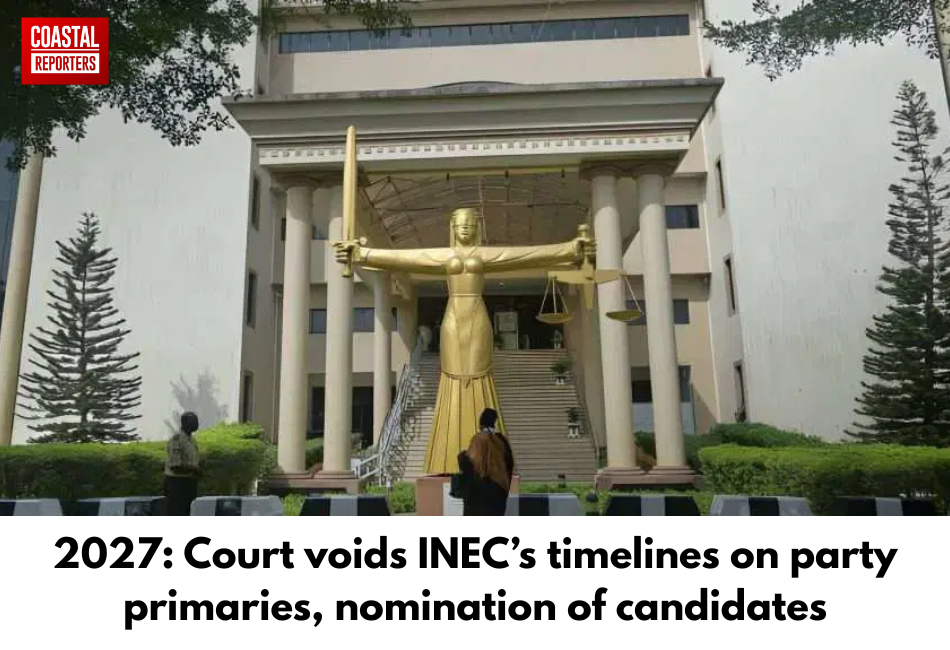
Ahead of the 2027 general elections, political parties have secured a major legal victory after a Federal High Court in Abuja nullified aspects of the timetable issued by the Independent National Electoral Commission (INEC) for party primaries and candidate nominations.
In a landmark judgment delivered by Justice Mohammed Umar, the court struck out INEC’s May 10 deadline which required political parties to submit their membership registers and databases as a prerequisite for participating in the elections.
The court ruled that the timelines imposed by INEC for the conduct of party primaries, submission of candidates’ particulars, as well as the withdrawal and substitution of candidates, were inconsistent with the provisions of the Electoral Act, 2026.
The ruling followed a suit instituted by the Youth Party (YP), which challenged INEC’s authority to impose timelines outside those stipulated by law. The party argued that the Electoral Act already provides a 120-day deadline for the submission of candidates’ particulars ahead of elections.
Although the judgment was delivered earlier in the week, the Certified True Copy (CTC) became available on Thursday.
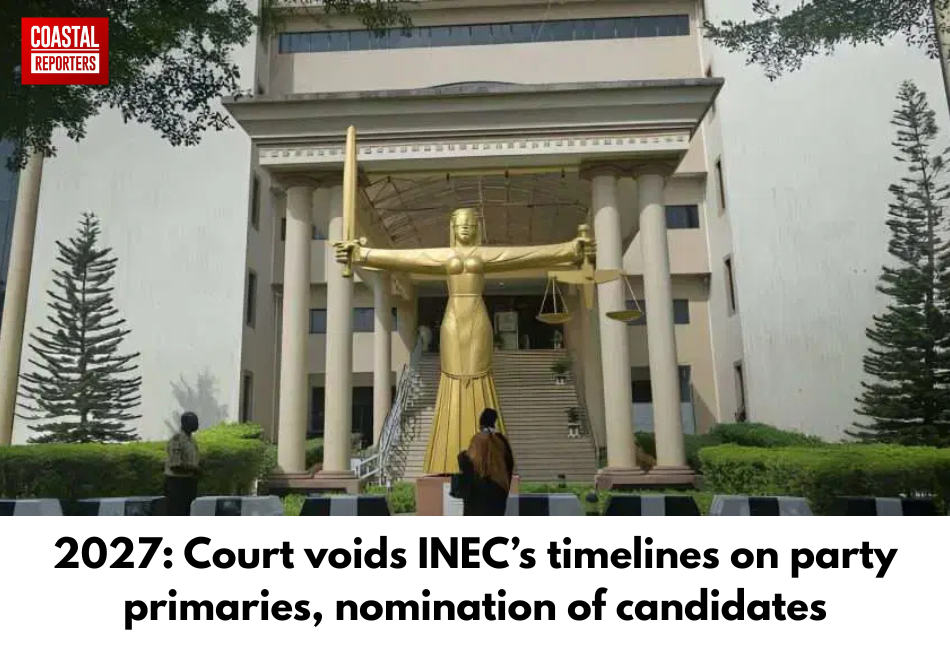
In suit No. FHC/ABJ/CS/517/2016, where INEC was the sole defendant, the plaintiff urged the court to interpret Sections 29, 82, and 84(1) of the Electoral Act, 2026, insisting that while INEC has powers to monitor party primaries, it does not possess the authority to dictate the timetable for such exercises.
Justice Umar agreed with the argument and held that under Section 29(1) of the Electoral Act, political parties are only required to submit the particulars of their candidates not later than 120 days before an election. Consequently, the court ruled that INEC cannot shorten or restrict that statutory period through administrative guidelines.
The court further held that Section 31 of the Electoral Act allows political parties to withdraw or replace candidates up to 90 days before an election, adding that INEC lacks the legal authority to impose earlier deadlines.
Similarly, Justice Umar ruled that Section 32 of the Electoral Act does not empower INEC to publish the final list of candidates earlier than the 60-day minimum period prescribed by law.
The court also declared invalid INEC’s directive that campaigns must end two days before elections, holding that such a provision exceeded the Commission’s powers under Section 98 of the Electoral Act, 2026.
In addition, the court clarified that the requirement for submission of party membership registers does not apply in cases involving the replacement of withdrawn candidates.
Consequently, the court nullified all portions of INEC’s Revised Timetable and Schedule of Activities for the 2027 General Elections that conflict with the Electoral Act, including timelines relating to primaries, candidate submissions, substitutions, publication of candidates’ lists, and campaign activities.
Reacting to the judgment, the Coalition of United Political Parties (CUPP) and several other political parties urged INEC to immediately comply with the ruling by revising its election timetable.
Acting National Chairman of CUPP, Peter Ameh, described the judgment as progressive and consistent with constitutional principles.
According to him, the ruling has expanded democratic space, strengthened party autonomy, and restored flexibility to political parties in managing their internal processes.
Ameh warned that any attempt by INEC to appeal the judgment could create uncertainty and erode public confidence ahead of the 2027 elections.
He also disclosed that at least 14 political parties had already resolved to extend their internal schedules to accommodate new entrants and ensure a more inclusive nomination process.
Meanwhile, former presidential candidate Gbenga Hashim said the judgment vindicated his long-standing position that INEC had exceeded its powers under the Electoral Act.
Hashim commended Justice Umar for what he described as a courageous decision that reaffirmed the supremacy of the law over administrative actions.
He noted that he had previously warned against any attempt to undermine the Electoral Act through regulations inconsistent with its provisions, adding that the judgment was necessary to safeguard the integrity of Nigeria’s electoral process and democratic governance.