

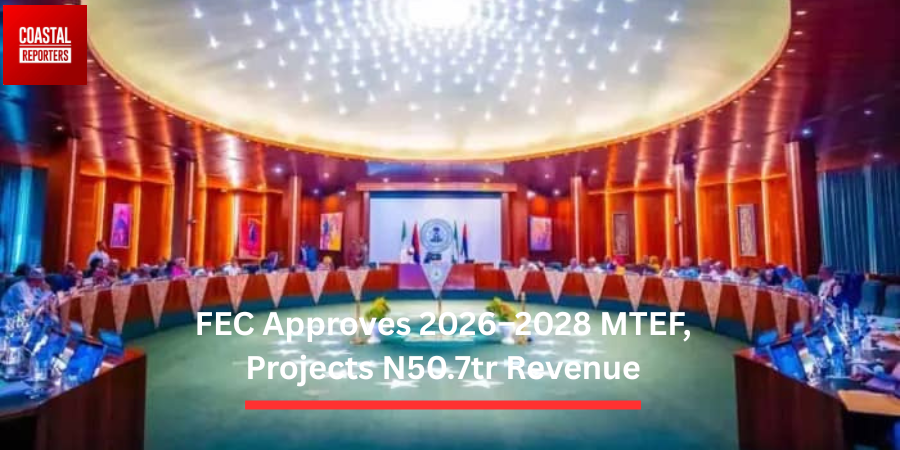
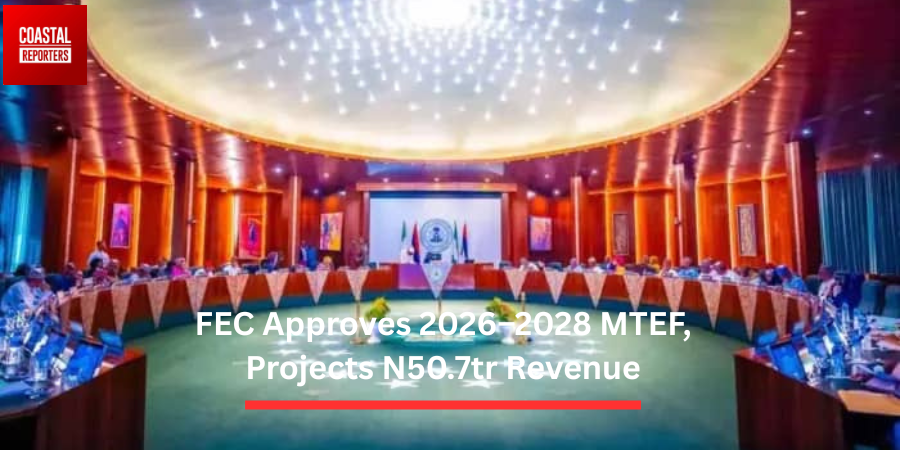
The Federal Executive Council (FEC) has approved the 2026–2028 Medium-Term Expenditure Framework (MTEF) and Fiscal Strategy Paper (FSP), projecting a 4.68% economic growth rate and total federation revenue of ₦50.74 trillion.
According to the revenue allocation formula, the Federal Government will receive ₦22.6 trillion, states ₦16.3 trillion, and local governments ₦11.85 trillion. Government-owned enterprises are expected to generate ₦34.33 trillion in revenue.
The framework outlines major macroeconomic assumptions for the 2026 budget, including a crude oil benchmark price of $64.85 per barrel and an exchange rate of ₦1,512 to $1.
Speaking to State House correspondents after the meeting chaired by President Bola Tinubu, Minister of Budget and Economic Planning, Senator Atiku Bagudu, said the plan reflects wide consultations across government agencies, the private sector, civil society, and development partners.
For the first time, the government separated its oil production “target” from its “benchmark” figures. Operators have been mandated to produce 2.06 million barrels per day (mbpd) in 2026, while a conservative benchmark of 1.8 mbpd was adopted for budget planning.
Total federal revenue from all channels is estimated at ₦34.33 trillion — representing a 16% (₦6.55 trillion) drop compared to the 2025 projection.
Expenditure estimates include ₦3 trillion for statutory transfers, ₦15.91 trillion for debt servicing, and ₦15.27 trillion for non-debt recurrent spending. The budget deficit is pegged at ₦20.1 trillion, equivalent to 3.61% of GDP.
Bagudu noted that the MTEF/FSP will be forwarded to the National Assembly as required by the Fiscal Responsibility Act. He added that President Tinubu has directed stronger coordination between fiscal and monetary authorities, increased security expenditure, stricter checks against revenue leakages, and greater investment in infrastructure and domestic production.
“Mr President believes that having stabilised the macro-economy, we must sustain the reforms,” he said.
Finance and Coordinating Minister of the Economy, Wale Edun, disclosed that FEC also endorsed two concessional loans: a $100 million African Development Bank facility for the Youth Investment Fund targeting Nigerians aged 18–35, and a $50 million Islamic Development Bank–supported agricultural project for Yobe State. He stressed that both loans are low-cost and geared toward productive sectors.
Edun also noted that President Tinubu praised cabinet members for advancing the Renewed Hope Agenda, highlighting Nigeria’s Q3 2025 GDP growth of 3.89%, driven by improvements in agriculture and industry. However, the President emphasized the need to accelerate growth towards his 7% target to effectively reduce poverty.