


Nigeria, UAE Remove Tariffs on Over 13,000 Products in New Trade Deal
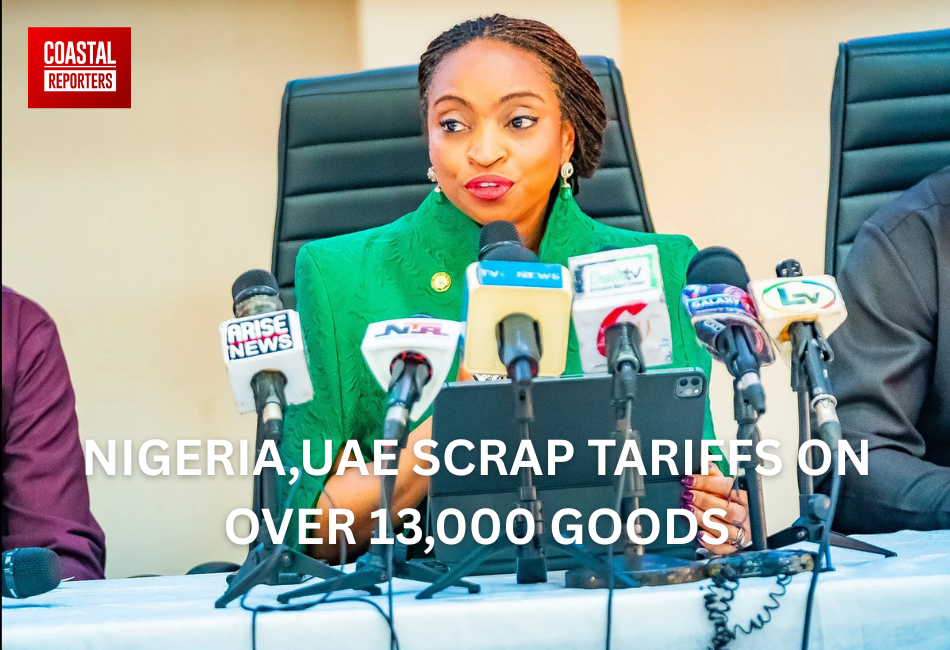
The Federal Government has announced that Nigeria and the United Arab Emirates have mutually removed tariffs on more than 13,000 products under a newly signed trade agreement aimed at boosting bilateral trade, investment, and economic cooperation.
According to the Federal Ministry of Industry, Trade, and Investment, Nigeria has eliminated tariffs on 6,243 products imported from the UAE, while the UAE has removed tariffs on 7,315 Nigerian products. The development follows the signing of the Nigeria–UAE Comprehensive Economic Partnership Agreement (CEPA) in January 2026.
The ministry explained that the agreement is designed to expand market access for Nigerian goods, businesses, and professionals in the UAE, while also encouraging investment flows between both countries. It described the pact as a major milestone in Nigeria’s non-oil export and economic diversification drive.
Under the agreement, Nigeria will immediately eliminate tariffs on 3,949 products, representing 63.3 per cent of the total, and gradually phase out tariffs on 2,294 products over five years. However, 123 products have been excluded from tariff liberalisation.
Similarly, the UAE will immediately remove tariffs on 2,805 Nigerian products, phase out tariffs on 1,468 products within three years, and remove tariffs on 3,042 products over five years. A total of 593 products have been excluded or prohibited by the UAE.
The CEPA was signed on January 13, 2026, by Nigeria’s Minister of Industry, Trade and Investment, Dr Jumoke Oduwole, and the UAE Minister of Foreign Trade, Dr Thani bin Ahmed Al Zeyoudi, in the presence of President Bola Tinubu and UAE President Sheikh Mohamed bin Zayed Al Nahyan.
The agreement will open the UAE market to a broad range of Nigerian agricultural, primary, industrial, and manufactured goods. Tariffs on products such as fish and seafood, cereals, oilseeds, fruits and nuts, live animals, meat products, cotton, and raw hides will be removed immediately. Other products, including cocoa, coffee, tea, mineral fuels, wood products, precious stones, and oils, will have tariffs phased out over three to five years.
For industrial and manufactured goods, the UAE will immediately remove tariffs on pharmaceuticals, chemicals, paper products, printed materials, and newspapers, while tariffs on machinery, vehicles, electrical equipment, furniture, apparel, footwear, ceramics, and glass will be eliminated gradually.
However, the UAE will maintain import bans on certain items, including pork products, narcotics, used tyres, and asbestos-related materials.
On Nigeria’s side, tariffs on UAE exports such as mineral fuels, machinery, vehicles, electrical equipment, iron and steel, and plastics will be removed immediately, while tariffs on fish, fruits, vegetables, and apparel will be phased out over five years. Nigeria has excluded products such as meat and dairy items, tomato paste, alcoholic beverages, soaps, detergents, and some textile products from the agreement.
Beyond goods, the CEPA also strengthens cooperation in services and investment. Nigeria has made commitments in 99 service areas across 10 sectors, while the UAE has committed to 108 services across 11 sectors. The agreement allows Nigerian business visitors to enter the UAE for trade and investment purposes and permits Nigerian companies to establish operations there.
The Federal Government stated that the agreement will accelerate non-oil exports, create jobs, attract quality investment, and support the Renewed Hope Agenda. It also reaffirmed that the CEPA aligns with Nigeria’s obligations under the World Trade Organisation, AfCFTA, and ECOWAS trade frameworks.
The government has pledged to work with relevant agencies to ensure smooth implementation and advised exporters and investors to seek guidance from the Ministry of Industry, Trade, and Investment and other relevant institutions.