


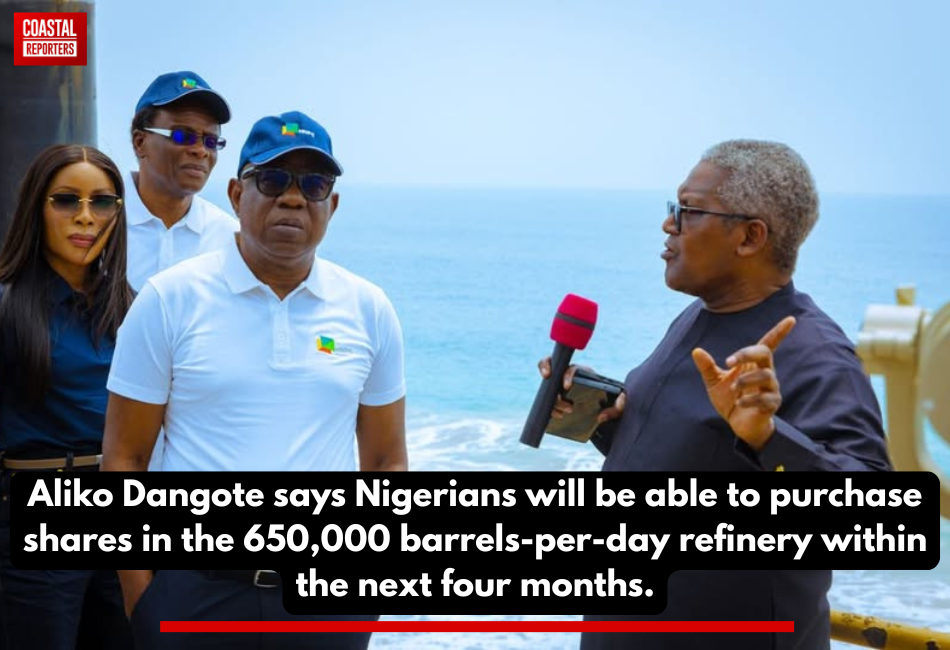
Africa’s richest businessman, Aliko Dangote, has announced that Nigerians will soon have the opportunity to purchase shares in his 650,000 barrels-per-day refinery located in Lagos, a step aimed at expanding local ownership of the multi-billion-dollar project.
He revealed that the share offer will be open to individual investors within the next four to five months, allowing everyday Nigerians to directly benefit from the refinery’s earnings. Investors will also have the choice of receiving dividends in either naira or dollars.
Owned by the Dangote Group, the refinery is recognized as the largest single-train refinery in the world. It became fully operational in late 2024 and has the capacity to process 650,000 barrels of crude oil daily. The facility is expected to play a major role in cutting Nigeria’s reliance on imported refined petroleum products.
Dangote further disclosed that the Nigerian National Petroleum Company Limited (NNPC) currently owns about 7.25 percent equity in the refinery, following its $1 billion investment in the project. He likened NNPC’s stake to Elon Musk’s shareholding in Tesla, emphasizing the strategic significance of the refinery.
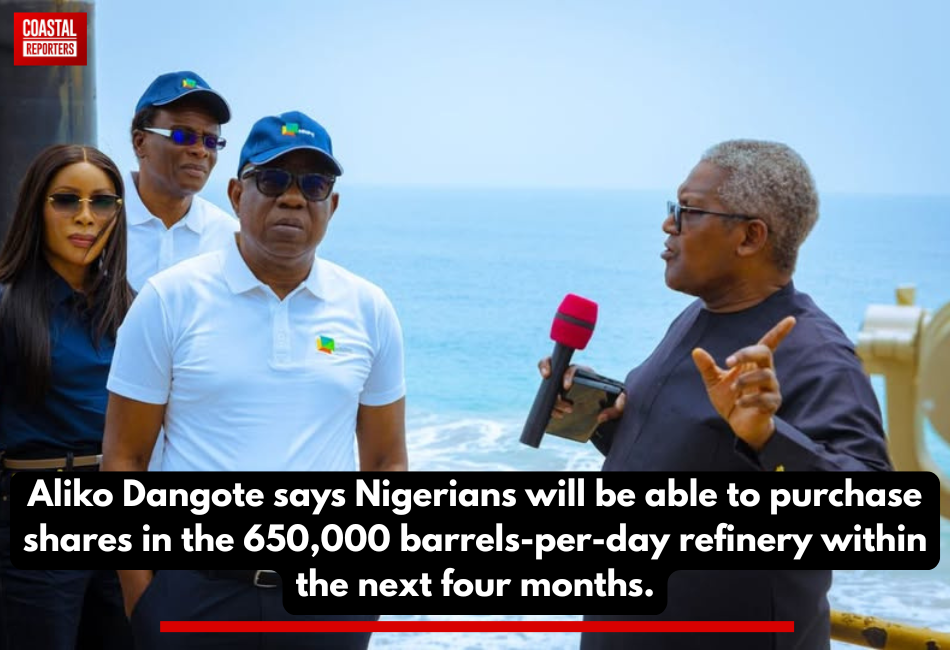
According to Dangote, “NNPC holds about 7.25 percent shares in Dangote Refinery, even more than Elon Musk’s stake in Tesla. Nigerians will be able to buy shares in the refinery individually in about four to five months and earn dividends in naira or dollars.”
The announcement has sparked enthusiasm among business and investment communities, as it suggests a potential public listing or structured share offer for one of Africa’s most important industrial ventures. Analysts believe opening the refinery to retail investors could boost participation in the capital market and create new wealth-building opportunities.
The Group Chief Executive Officer of NNPC, Bayo Ojulari, has previously commended the refinery for enhancing Nigeria’s energy security. He noted that the facility is transforming the downstream petroleum sector by expanding local refining capacity and reducing dependence on expensive fuel imports.
Since reaching full operations, the refinery has started supplying petrol, diesel, aviation fuel, and other petroleum products to the domestic market, while also positioning itself to export to other African nations and global markets.