


Financial and economic experts have described the ongoing recapitalization of Nigerian banks as vital for economic stability, while warning that weak regulation and macroeconomic instability could undermine its effectiveness.
Speaking separately with the News Agency of Nigeria (NAN) in Ibadan on Wednesday, the experts expressed broad support for the exercise, noting that it had become necessary due to the erosion of banks’ capital bases caused by sustained naira depreciation, rising inflation, and the expansion of the Nigerian economy.
The Oyo State Chairman of the Nigerian Economic Society (NES), Dr Alarudeen Aminu, explained that the current recapitalisation effort was focused more on restoring the real value of banks’ capital than on expanding their operational capacity.
He said the Central Bank of Nigeria’s (CBN) decision to increase minimum capital requirements was commendable, but cautioned that recapitalisation alone could not guarantee financial system stability.
Aminu stressed that unresolved challenges such as inflation and exchange-rate volatility could limit the impact of the exercise. He recalled that the 2004–2005 recapitalisation exposed serious governance lapses, including fund diversion and excessive stock market speculation, which eventually led to bank failures.
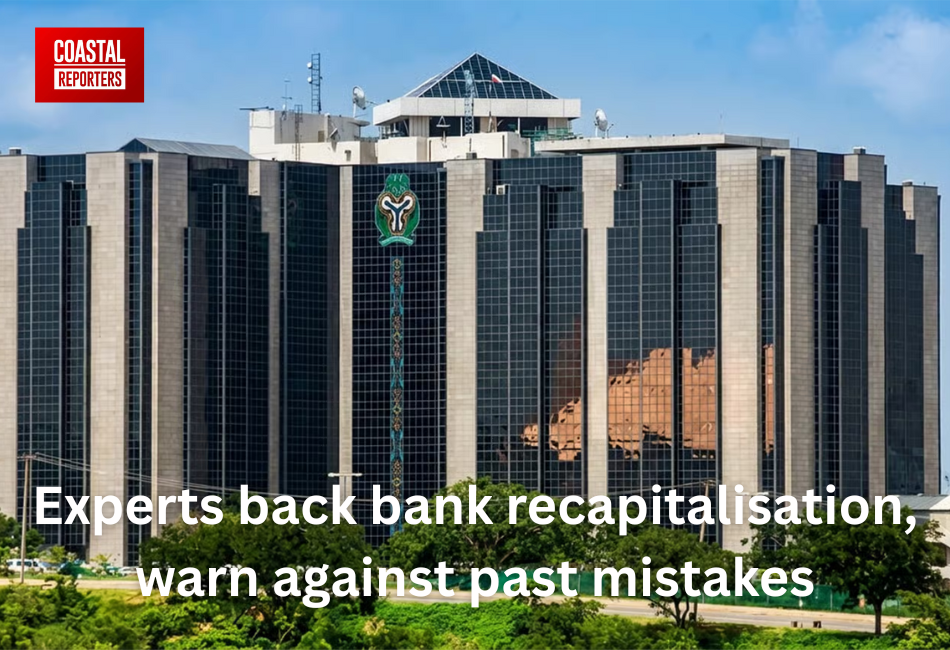
According to him, although banks were flush with funds at the time, the expected investment outcomes did not materialise, as some institutions channelled resources into buying their own shares rather than supporting productive sectors. He added that the current review of capital requirements was also intended to make Nigerian banks more competitive regionally and globally.
Similarly, the Acting Head of the Department of Banking and Finance at the University of Ibadan, Dr Ifeayin Onwuka, said strong capital buffers were crucial for banks to absorb economic shocks and finance large-scale projects.
He noted that poor capitalisation in the past constrained Nigerian banks from participating in major transactions, adding that the country’s ambition of becoming a one-trillion-dollar economy required strong and globally competitive financial institutions.
Onwuka also pointed out that periodic recapitalisation was inevitable due to inflation and exchange-rate depreciation, urging banks to raise capital proactively in line with Basel I, II and III standards rather than waiting for regulatory directives.
A financial consultant, Mr Tunde Adepeju, described the recapitalisation as timely, given the increasing volume of financial transactions and the central role banks play in driving industrial and commercial growth.
He observed that the economy had grown significantly over the years, and insufficient bank capital would limit lending to businesses, particularly in the productive and industrial sectors. Adepeju also commended the CBN’s differentiated capital requirements for international, national and regional banks, describing them as fair and practical.
He added that many banks had already met the new thresholds through rights issues and private placements, noting that bank failures could have far-reaching consequences for the economy. According to him, recapitalisation, mergers, and acquisitions were necessary to protect depositors and safeguard financial stability.
Overall, the experts agreed that while recapitalisation was essential, its success depended on sound macroeconomic policies, effective regulation, and strict oversight to prevent a recurrence of past failures.