


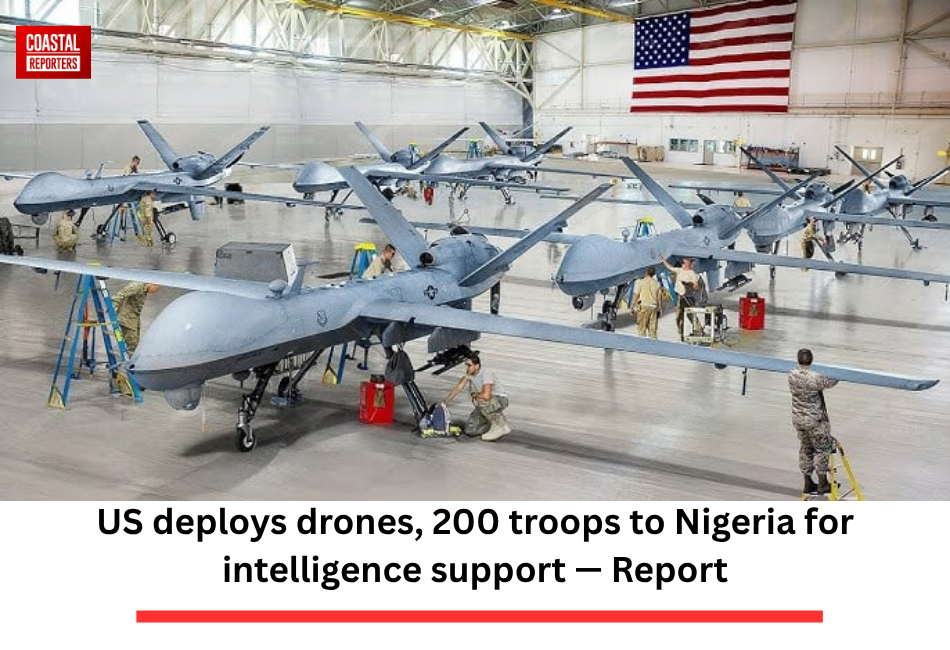
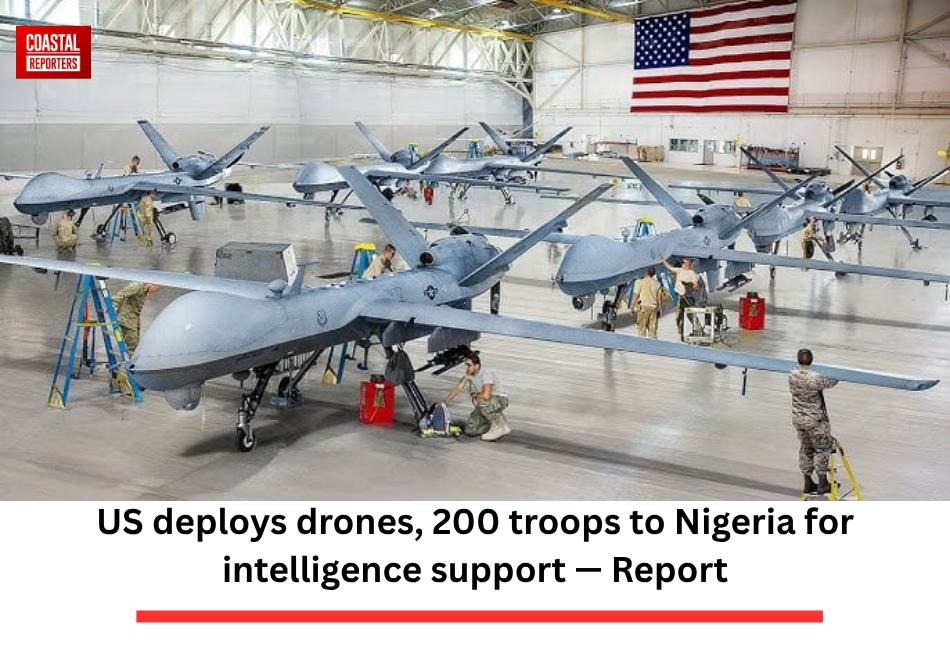
The United States has deployed several MQ-9 drones and about 200 troops to Nigeria to support the country’s military with intelligence gathering and training in its ongoing fight against insurgency in the northern region.
The mission is strictly limited to surveillance and advisory roles, with no U.S. personnel involved in frontline combat and no drone strikes being carried out.
U.S. and Nigerian officials told Reuters that the drones and troops are being used to enhance intelligence operations and build military capacity. The deployment was made at the request of the Nigerian government to help detect, monitor, and respond to terrorist threats.
A U.S. defence official described the effort as a response to a shared security concern, emphasizing that the operation is focused solely on intelligence collection and support.
Major General Samaila Uba, Director of Defence Information at Nigeria’s Defence Headquarters, confirmed that U.S. forces are operating from an airfield in Bauchi State in the northeast.
He explained that the support is part of a broader U.S.-Nigeria intelligence collaboration, which has improved the flow of actionable intelligence to field commanders. He also reiterated that American personnel remain in a non-combat role, supporting operations led by Nigerian forces.
The MQ-9 drones, commonly known as Reapers, can stay airborne for over 27 hours and are capable of both surveillance and strike missions. However, officials stressed that in this case, they are being used only for intelligence gathering.
This development comes as violence continues to escalate in parts of northern Nigeria. On March 16, suicide bombers attacked a military garrison in the northeast, highlighting the ongoing threat posed by groups such as Boko Haram and the Islamic State West Africa Province (ISWAP).
According to Uba, these groups are likely to continue targeting vulnerable locations and may attempt high-profile attacks to assert their presence.
The Nigerian military stated that the length of the U.S. deployment will be determined through ongoing discussions between both countries, reflecting a growing emphasis on intelligence sharing and strengthening military capabilities.
The latest move follows earlier U.S. military actions, including airstrikes carried out on Christmas Day under President Donald Trump, targeting ISIS-linked militants in northwest Nigeria. The Federal Government said the strikes were part of a coordinated effort with international partners to combat terrorism.
Earlier reports had also indicated that about 200 U.S. troops were deployed to Nigeria to provide training and operational support, with the aim of boosting the country’s counterterrorism efforts through improved intelligence and capacity building.